
I fell in love around my 16th birthday while visiting relatives in Zagreb. That’s when I first saw a painting by Ivan Rabuzin (1921 – 2008). My heart fluttered and I knew I’d remember that painting for the rest of my life. It was such a beautiful, ethereal landscape that I wanted to fly right through it.
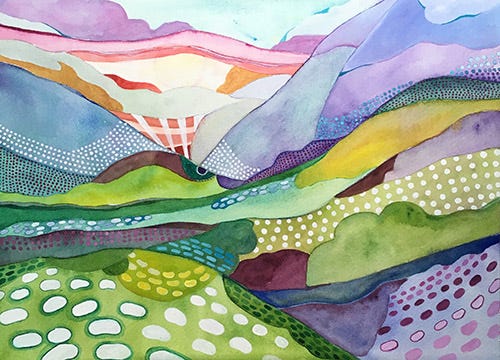
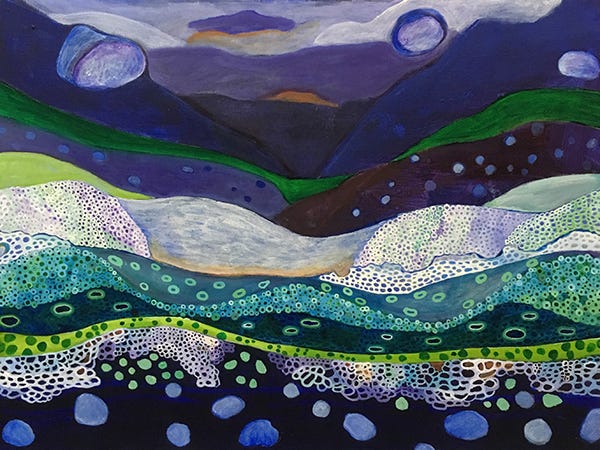
Like all great artists, Rabuzin imbued his paintings with a touch of infinity. There’s no limit to how long I could look at his work. Since I paint intuitively, I’m not always immediately aware of the artists who influence my style. In Rabuzin’s case, I didn’t realize the powerful impression he made on me until a few years ago when I returned to California, and began painting surrealist landscapes.
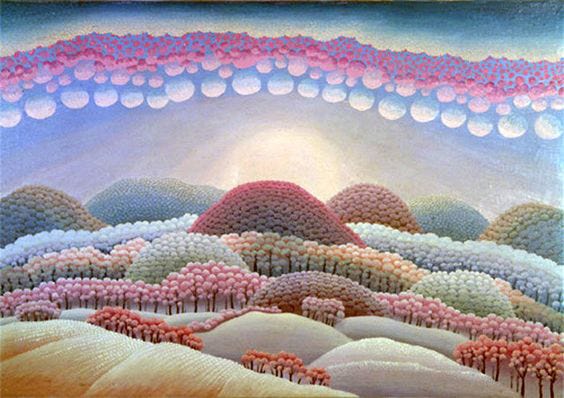
While relatively unknown in the U.S., Ivan Rabuzin remains a significant figure in the world of Yugoslav Naïve painting, a genre of self-taught outsider artists. Born in 1921, the sixth of eleven children, to a mining family in the vicinity of Varazdin, a picturesque area of northern Croatia, Rabuzin worked as a carpenter and like many artists, painted in his free time. By 1963, at the age of 42, he had developed his signature lyrical landscape style and gained enough recognition that he gave up his day job and could paint full time.
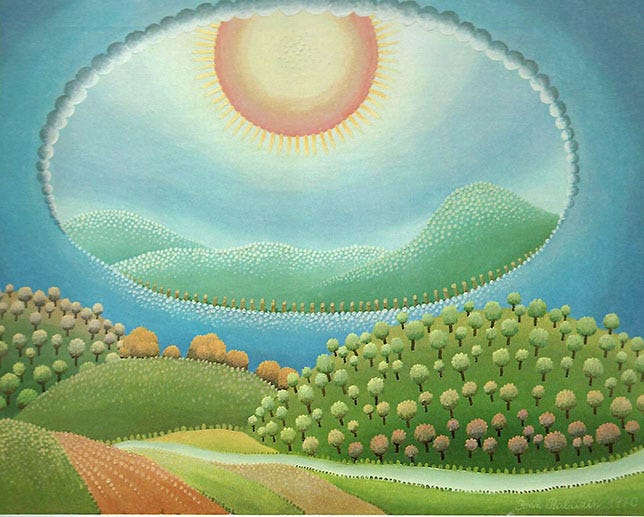
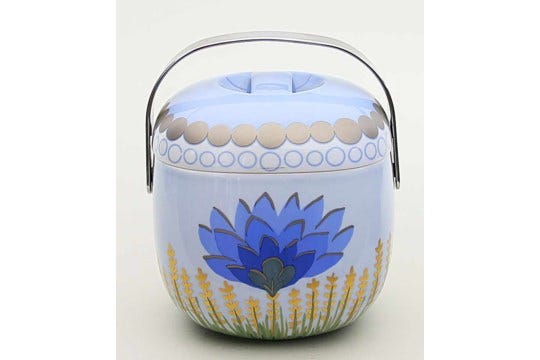
Beyond Croatia and the former Yugoslavia, Rabuzin’s work is known among collectors and critics of European naïve art. The French art critic and founder of a Museum of Naïve Art in Nice, Anatole Jaovsky considered Rabuzin “one of the greatest naïve painters of all times and countries.”[i] Along with Dali and Vaserely, Rabuzin was also commissioned to design dinnerware for by Rosenthal.[ii] Along with several other Croatian naïve artists he enjoyed success in Japan where one of his designs was used for the curtain in Tokyo’s Takarazuka Theater.
Not surprisingly scholars have intellectualized Rabuzin’s approach to landscape painting by implying that he consciously reduced natural forms into their nearest geometric shape. Right angles are rare in nature, so his paintings are full of spherical shapes arranged in patterns gently implying perspective and horizon. Often breaking from conventional perspective, Rabuzin depicts gigantic flowers in the midst of hills, covered by trees arranged in harmonious patterns. When he includes buildings, usually villages, they are secondary to nature and are used to visually enhance his version of the natural world.
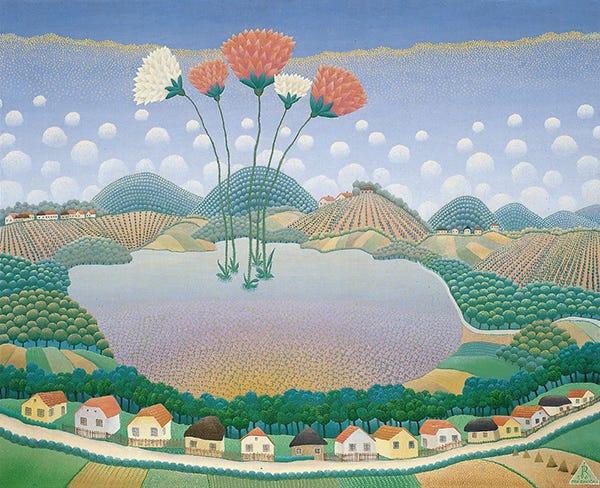
Rabuzin’s work is controlled and technically precise but also has a powerful meditative quality. His images don’t feel like conclusions reached through conscious intellectual thought, but feel intuitive and heart felt. Beyond “unique” or “interesting,” Rabuzin’s paintings are truly inspiring. distinctive and honest and have influenced my own work.
Years later when painting the mountains of Southern California, I realized the deep impression that painting hanging on my uncle’s wall made on me as a teenager. Rabuzin- like patterns often appear in my landscapes uniting two of my “homes”, Croatia and California, and transforming those surrealistic scenes into self-portraits.
[i] The 95th anniversary of the birth of Ivan Rabuzin". hmnu.hr (in Croatian). Croatian Museum of Naïve Art. 24 March 2016.
[ii] Rosenthal GmbH is one of the most traditional branded goods companies in Germany. Founded over 140 years ago, today Rosenthal develops porcelain products and interior collections for end consumers as well as professionals in the discerning gastronomy and hotel industry.
I have a Magnum bottle with 4 small pictures by Rabuzin. It was given to me when I resided in Croatia. It is beautiful.